Publications
Peer-reviewed papers, newest first. Open an entry for a figure and a plain-language summary; each DOI goes to the publisher's version.
Peer-reviewed papers
- 2026
Cornejo, I. C., A. K. Rowe, M. M. Bell, and W.-Y. Chang, 2026: Modeling rainfall drop size distribution moments using an S-band polarimetric radar in complex terrain. Quarterly Journal of the Royal Meteorological Society. doi:10.1002/qj.70254
Summary and figure
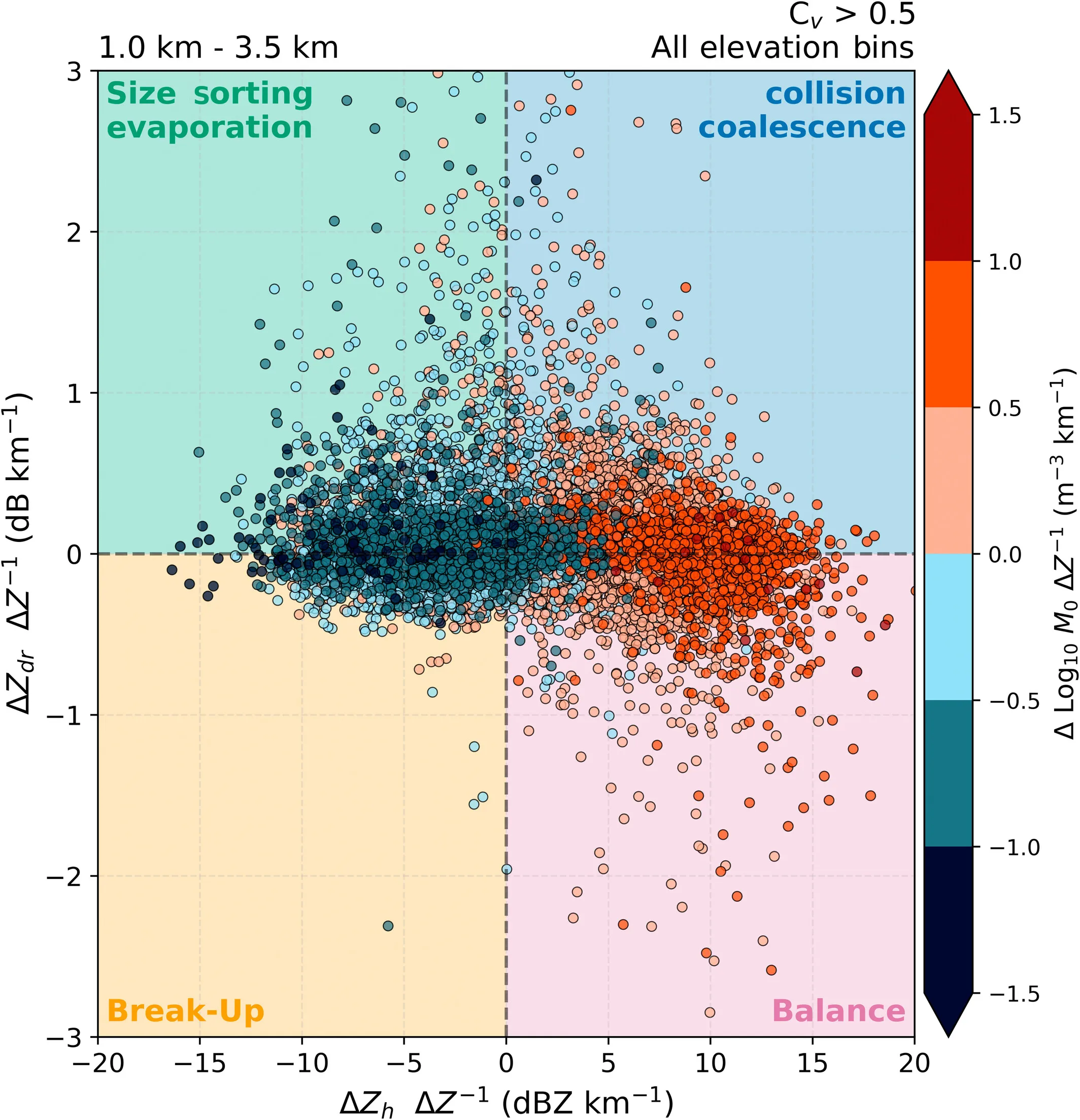
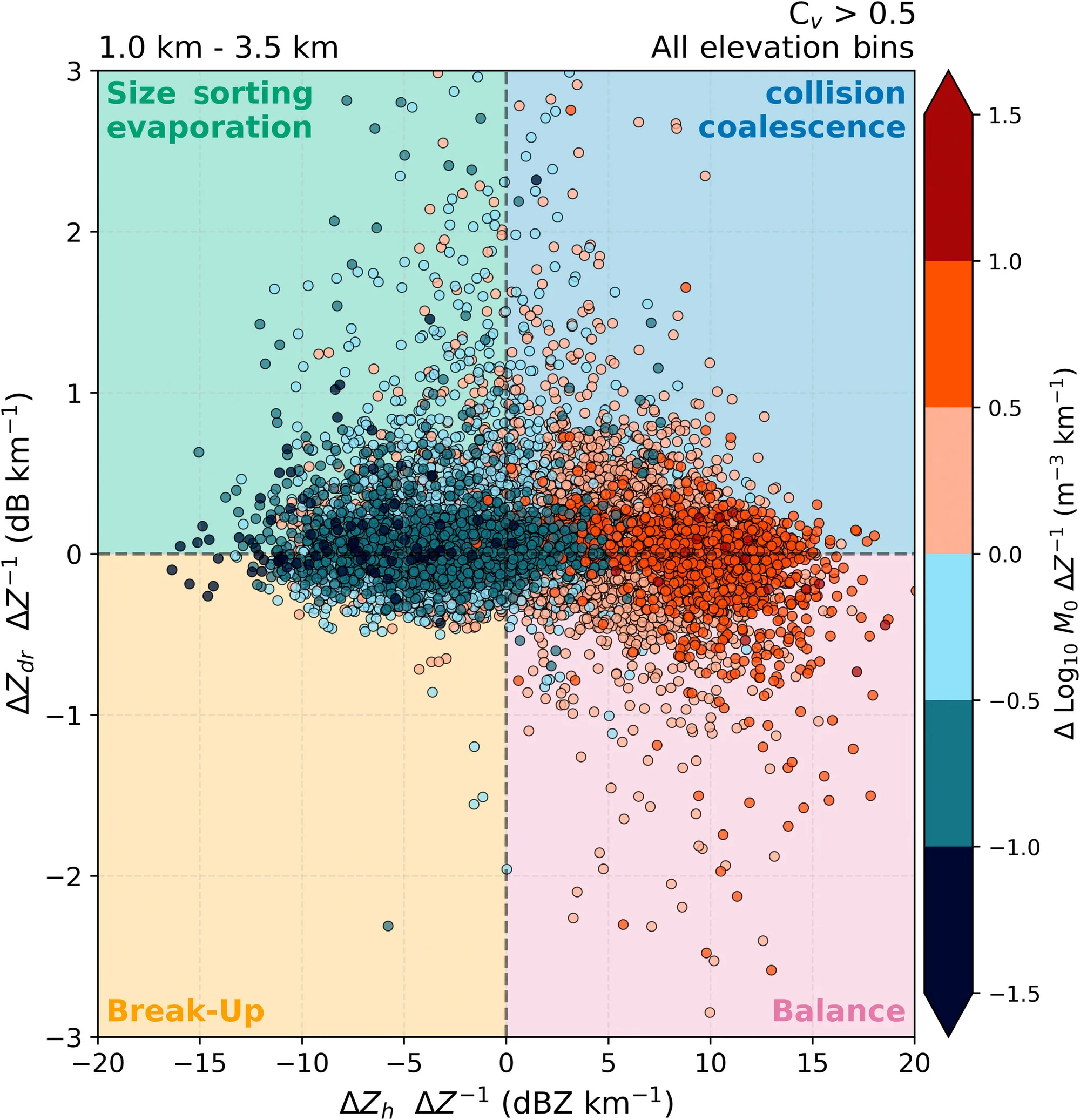
Warm-rain process fingerprints in convection (Cv > 0.5) between 1.0 and 3.5 km: vertical changes in ZH and ZDR, colored by the change in total drop concentration (log10 M0). Cornejo et al. (2026), Quarterly Journal of the Royal Meteorological Society. © 2026 The Author(s), published by John Wiley & Sons Ltd on behalf of the Royal Meteorological Society under a CC BY 4.0 license.
Plain-language summary
Using S-band dual-polarization radar and disdrometers during PRECIP 2022 in Taiwan, we analyze a Mei-Yu frontal event with widespread stratiform rain and embedded convection. Multiple disdrometers are used to create a novel drop size distribution model for S-band radars resolving both the drizzle and precipitation modes. The model reveals both inferred collision–coalescence and graupel presence increases drop size and concentration, subsequently increasing rainfall rates, most notably in complex terrain.
- 2025
Cornejo, I. C., A. K. Rowe, M. J. Dixon, and U. Romatschke, 2025: Specific Attenuation-Based Rain-Rate Applicability to Varying Rainfall Intensity in Complex Terrain. Journal of Atmospheric and Oceanic Technology, 42, 889–907. doi:10.1175/JTECH-D-24-0094.1
Summary and figure
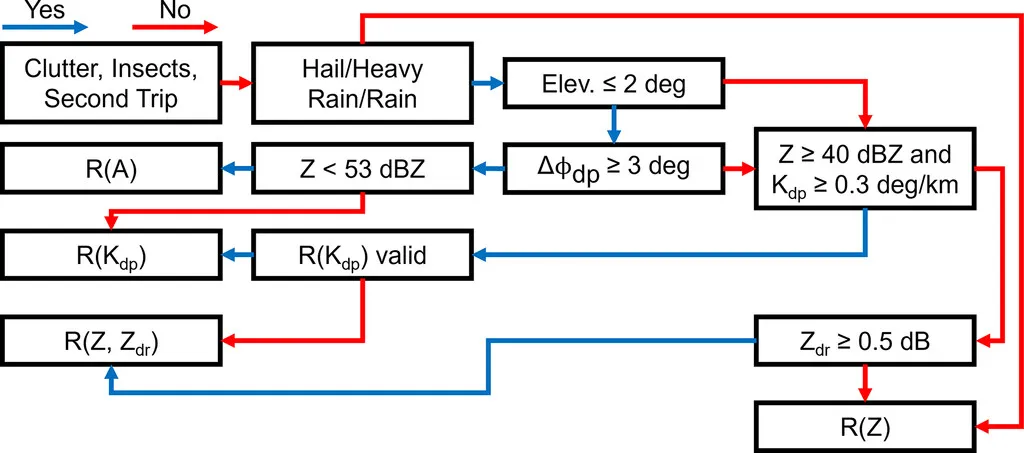
Decision tree for the new combined technique, which uses R(A) where it performs best and falls back to R(KDP), R(Z, ZDR) or R(Z) elsewhere. Cornejo et al. (2025), Journal of Atmospheric and Oceanic Technology. © Copyright 2025 American Meteorological Society (AMS). For permission to reuse any portion of this Work, please contact permissions@ametsoc.org.
Plain-language summary
Heavy rainfall is impactful globally, but difficult to accurately measure, especially in remote mountainous regions. Radar is useful for estimating rainfall, but encounters challenges in steep terrain owing to partial or total beam blockage. This study examines the advantages and disadvantages of applying a rain estimation technique based on radar attenuation, or loss of a signal by precipitation, to a 3-month radar deployment in mountainous Taiwan. This technique performed best in extreme rainfall scenarios, but not as well in lighter rainfall. Nearby terrain amplifies errors compared to other rain estimation methods, regardless of intensity. A unique aspect of this study is the development of a new rain-rate estimation technique, combining multiple retrievals to take advantage of their individual strengths.
- 2024
Cornejo, I. C., A. K. Rowe, K. L. Rasmussen, and J. C. DeHart, 2024: Orographic Controls on Extreme Precipitation Associated with a Mei-Yu Front. Monthly Weather Review, 152(2), 531–551. doi:10.1175/MWR-D-23-0170.1
Summary and figure
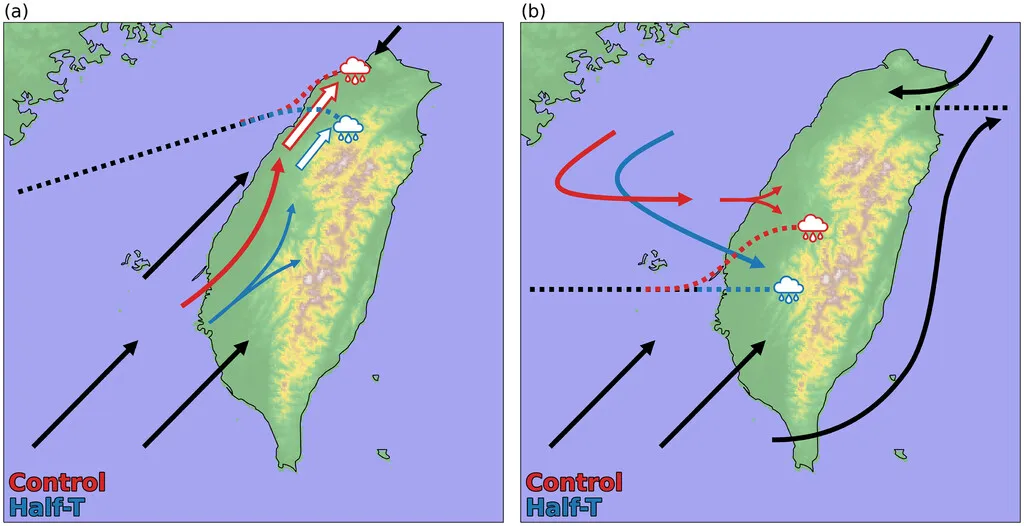
How Taiwan's terrain steers the mei-yu front over (a) northern and (b) central Taiwan, comparing the control simulation (red) with halved terrain (Half-T, blue). Cornejo et al. (2024), Monthly Weather Review. © Copyright 2024 American Meteorological Society (AMS). For permission to reuse any portion of this Work, please contact permissions@ametsoc.org.
Plain-language summary
This study examines the impact of terrain on rainfall intensity, duration, and location. A mei-yu front, an East Asian weather front known for producing heavy, long-lasting rainfall, was simulated for an extreme rain event in Taiwan with mountain heights halved as a sensitivity test. Reducing terrain decreased rainfall duration in northern and central Taiwan. Decreases in rainfall duration for both regions is attributed to increased mei-yu front propagation speed. This increase in northern Taiwan is attributed to a weakened barrier jet, a low-level jet induced by flow blocked by the steep mountains of Taiwan. A unique finding of this work is a change in winds north of the front controlling movement of the front near the mountains in central Taiwan.
In review and revision
Cornejo, I. C., A. K. Rowe, K.-S. Chung, S.-K. Yang, and J. C. DeHart: Leveraging Observations and Ensemble Model Skill to Identify Mesoscale Drivers of Extreme Mei-Yu Rainfall. Journal of Geophysical Research: Atmospheres, in revision.
Dissertation and thesis
- 2026
Cornejo, I. C., 2026: Echoes of Extreme Rainfall: Radar Perspectives of Multiscale Precipitation Controls. PhD dissertation, University of Wisconsin–Madison. PDF
- 2023
Cornejo, I. C., 2023: Orographic Controls on Extreme Precipitation associated with a Mei-yu Front. MS thesis, University of Wisconsin–Madison. PDF
Presentations
Conference talks and posters I gave as first author, and invited talks.
- 2027
AMS Annual Meeting, Denver, ColoradoUpcoming
Catching the Drizzle: Validating Complete Profiled Drop Size Distributions from a Snow-Level Radar During TIME-SLICE CO
- 2026
NSF NCAR Radar Technology Community Workshop, Boulder, Colorado
Radar-Derived Insights of Microphysical Processes Using the NSF NCAR S-Pol Radar
- 2025
AMS 41st International Conference on Radar Meteorology, Toronto, Canada
Radar-Derived Insights of Microphysical Processes during PRECIP 2022
- 2024
16th International Conference on Mesoscale Convective Systems (ICMCS), Gyeongju, South Korea
Specific Attenuation-based Rain Rate Applicability to the PRECIP/TAHOPE S-Pol Dataset near Complex Terrain
Microphysical Processes leading to Heavy Mei-Yu Rainfall near Complex Terrain during PRECIP/TAHOPE
- 2023
NCAR Earth Observing Laboratory Seminar Series, Boulder, Colorado
Extreme Rainfall in Taiwan: Observations from NCAR's S-Pol Radar during PRECIP/TAHOPE 2022
- 2023
AMS 40th Conference on Radar Meteorology, Minneapolis, Minnesota
Validation and Intercomparison of Rain Rate Retrievals using the S-Pol Radar during PRECIP
- 2023
AMS 20th Conference on Mesoscale Processes, Madison, Wisconsin
Orographic Modifications to Heavy Mei-Yu Rainfall
- 2023
15th International Conference on Mesoscale Convective Systems (ICMCS), Fort Collins, Colorado
Orographic Controls on Extreme Precipitation associated with a Mei-Yu Front
LROSE Tools to Estimate Surface Rain Rate
- 2022
AMS 20th Conference on Mountain Meteorology, Park City, Utah
Mei-yu Frontal Convergence and Heavy Rainfall in Taiwan's Complex Terrain
- 2021
Midwest Student Conference on Atmospheric Research
The Influence of Microphysical Processes in Extreme Rain Events Found in Complex Terrain
- 2021
AMS Annual Meeting, Virtual
The Influence of Microphysical Processes in Extreme Rain Events Found in Complex Terrain